
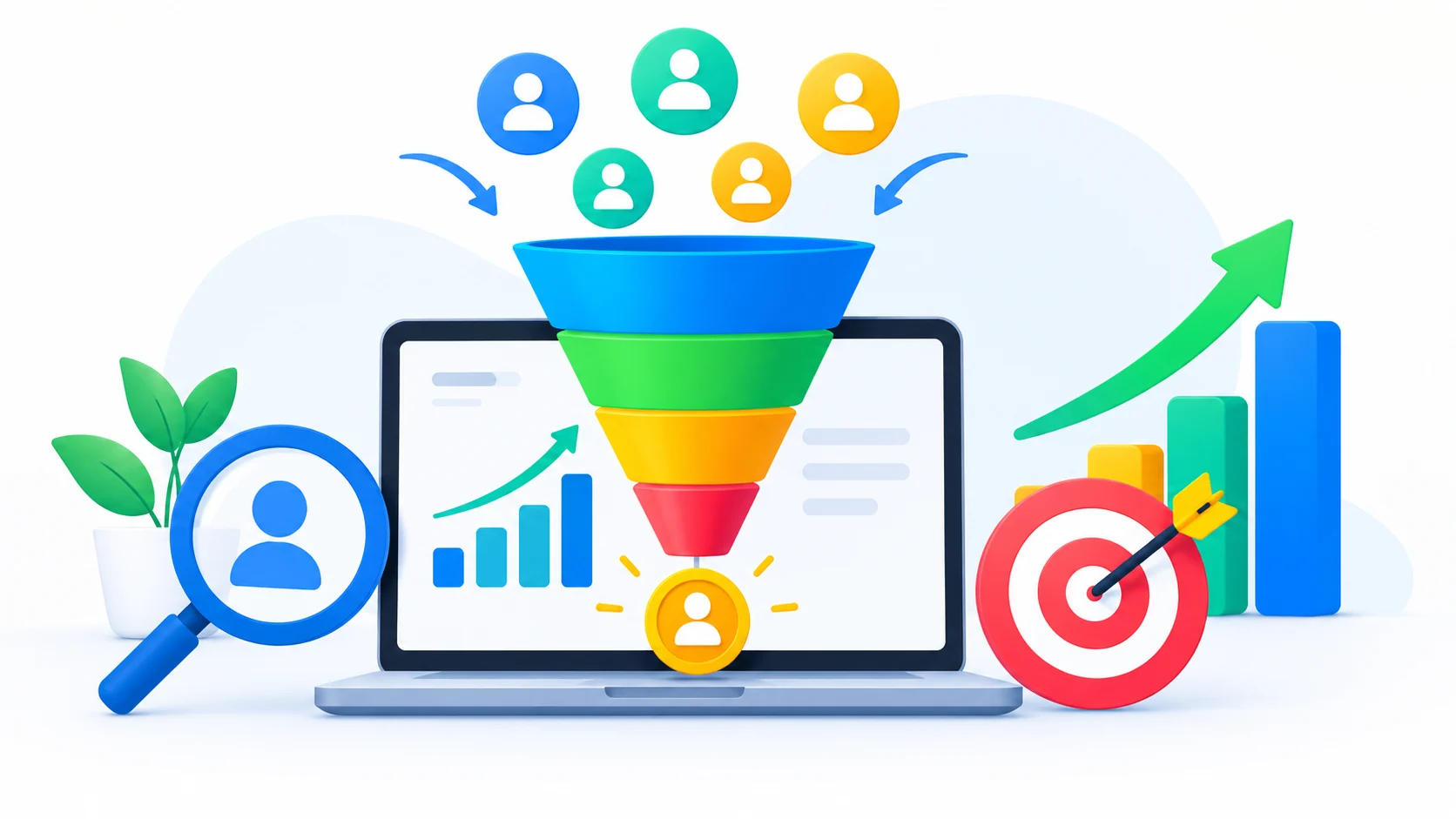
A website can attract thousands of visitors every month and still generate very few leads, inquiries, purchases, or other meaningful actions. Traffic is important, but traffic alone does not tell you whether a website is actually performing well. This is where conversion rate becomes an important metric.
Conversion rate measures the percentage of visitors or users who complete a specific action that you want them to take. That action could be filling out a contact form, booking a consultation, calling a business, signing up for an email list, downloading a resource, requesting a quote, or completing a purchase. In other words, conversion rate helps you understand how effectively your website turns opportunities into results.
For a law firm, this metric can be particularly useful. A website might rank well in search results and receive consistent organic traffic, but if visitors leave without contacting the firm, the traffic may not produce many new potential clients. Looking at conversion rate alongside traffic, rankings, leads, and lead quality provides a much clearer picture of website performance.
What Is Conversion Rate?
Conversion rate is the percentage of people who complete a desired action compared with the total number of people included in the measurement. The basic formula is:
Conversion Rate = (Number of Conversions ÷ Number of Visitors or Users) × 100
For example, imagine a law firm website receives 1,000 visitors during a month. If 30 visitors submit a consultation form, the conversion rate would be:
30 ÷ 1,000 × 100 = 3%
That means 3% of the measured visitors completed the conversion action.
The important point is that a conversion does not always mean a sale. A website owner decides what action represents a meaningful result for that particular website. An ecommerce store may consider a completed purchase a conversion, while a service business may consider a quote request a conversion. A law firm may track consultation requests, phone calls, contact form submissions, or appointment bookings.
What Counts as a Conversion?
A conversion is simply a completed action that supports a website's business objective. Because different websites have different goals, there is no single action that always qualifies as a conversion. A conversion could include:
Submitting a contact form
Booking an appointment
Requesting a consultation
Calling a business
Purchasing a product
Requesting a quote
Signing up for an email newsletter
Downloading a guide
Creating an account
Starting an application
Clicking a specific business action
Completing a registration
For a law firm website, the most valuable conversions are often connected to potential client inquiries rather than simple engagement actions. Someone spending five minutes reading a blog post may be valuable, but someone who reads the article and then requests a consultation has taken a much stronger commercial action.
How Do You Calculate Conversion Rate?
Calculating conversion rate is straightforward once you know the number of conversions and the number of visitors or users being measured. Suppose a website receives 5,000 visitors in one month and generates 100 completed contact forms.
The calculation would be: 100 ÷ 5,000 × 100 = 2%
The website therefore has a 2% conversion rate for that particular conversion goal.
However, you should always pay attention to what denominator you are using. Conversion rate can be calculated using sessions, users, visitors, leads, clicks, or other measurements depending on the analytics setup and the question you are trying to answer.
This means two reports can show different conversion rates even when they are measuring the same website. One report may calculate conversions based on users, while another calculates them based on sessions. Neither number is automatically wrong; they are simply measuring the behavior differently.
Why Is Conversion Rate Important?
Conversion rate helps connect website activity with business outcomes.
Traffic reports can tell you how many people visited your website. Search Console data can help you understand impressions and clicks. Ranking reports can show where your pages appear in search results. But conversion rate answers another important question:
What percentage of those visitors actually took the action you wanted?
This distinction matters because increasing traffic is not always the best way to improve business results. Imagine two websites:
Website A receives 10,000 visitors and generates 50 leads.
Website B receives 3,000 visitors and generates 90 leads.
Website A has more traffic, but Website B is producing more leads. If Website B is attracting highly relevant visitors and has a stronger conversion process, its smaller traffic volume may be more valuable. This is why website performance should not be judged by traffic alone.
Conversion Rate Example for a Law Firm
Consider a law firm that publishes content about personal injury claims. The page receives 2,000 organic visitors during a month. Out of those visitors:
40 submit a consultation form.
15 call the firm.
10 book an appointment online.
If the firm considers all three actions conversions, it needs to decide how those conversions should be counted and whether some actions overlap. If the same person submits a form and later books an appointment, counting both as separate unique leads could make the reported results misleading.
This is why good conversion tracking is more than simply installing an analytics tool. The business needs to clearly define what counts as a conversion and how different actions should be attributed.
If 40 unique visitors completed the primary consultation form, for example, the basic conversion rate would be: 40 ÷ 2,000 × 100 = 2%. That 2% gives the firm a useful starting point for evaluating the page.
Conversion vs. Conversion Rate
Aspect | Conversion | Conversion Rate |
Definition | An individual desired action that has been completed | The percentage of people who completed the desired action |
Measures | How many actions were completed | How effectively visitors completed the action |
Example | 25 people submit a form = 25 conversions | 25 conversions ÷ 1,000 visitors = 2.5% conversion rate |
Typical Measurement | Number of completed actions | Percentage of the measured audience that converted |
Why It Matters | Shows the total number of results generated | Shows how efficiently the website turns visitors into conversions |
Traffic Impact | More traffic can produce more conversions | A smaller website can have a higher rate but fewer total conversions |
Click-Through Rate vs Conversion Rate
Aspect | Click-Through Rate (CTR) | Conversion Rate |
Definition | Measures how often people click after seeing a link, ad, search result, email, or button | Measures how often people complete a desired action |
Main Focus | Clicks | Completed actions |
Key Question | “Are people clicking?” | “Are visitors taking the desired action?” |
Example | A search result gets 10,000 impressions and 500 clicks = 5% CTR | 500 website visitors generate 25 consultation requests = 5% conversion rate |
Customer Journey Stage | Mainly measures the click stage | Measures progress toward the desired action |
What It Can Reveal | How effectively a result, ad, or link attracts clicks | How effectively a website or page turns visitors into leads or other desired outcomes |
Law Firm Example | How often people click a law firm's search result | How often website visitors submit a consultation request |
Relationship | Helps bring people to the next stage | Helps measure what happens after they arrive |
What Is a Good Conversion Rate?
There is no universal conversion rate that every website should achieve. A rate that is excellent for one business may be poor for another. The result can vary based on industry, traffic source, search intent, offer, location, device, landing page, conversion type, audience, and many other factors.
For example, someone searching for a highly specific service may be much closer to taking action than someone reading a general informational article. Their likelihood of converting will naturally be different.
Instead of focusing only on an industry-wide benchmark, businesses should also establish their own historical benchmarks. Track the conversion rate over time and ask:
Is it improving?
Is it declining?
Which pages convert best?
Which traffic sources produce better leads?
Which devices perform better?
Which services generate more inquiries?
Are conversion increases producing better-quality leads?
A consistent improvement from your own baseline can be more useful than chasing an arbitrary percentage.
What Factors Affect Conversion Rate?
Many different elements can influence whether a visitor completes an action. Conversion rate is rarely controlled by one button or one headline alone.
Search Intent
The reason someone visits a page has a major impact on conversion potential. Someone searching for "what does a personal injury lawyer do" may be researching a topic and may not be ready to contact a firm. Someone searching for "personal injury lawyer near me" may have a much stronger service intent.
This means pages targeting different stages of the customer journey should not necessarily be expected to produce the same conversion rate.
Page Content
Visitors need enough information to understand what the business offers and why the next step makes sense. Thin, unclear, overly promotional, or poorly structured content can create uncertainty. Strong content answers the visitor's questions, explains the service clearly, addresses relevant concerns, and makes the next step obvious.
Calls to Action
A call to action tells visitors what they can do next. Examples include:
Request a Consultation
Contact Our Firm
Schedule an Appointment
Call Now
Request More Information
The wording, placement, visibility, and relevance of the call to action can influence conversions.
Page Speed and User Experience
A slow or difficult-to-use website can create unnecessary friction. Visitors may leave before they even reach the conversion point. Mobile usability is especially important because many users access websites from smartphones. Forms that are difficult to complete, buttons that are hard to tap, or pages that shift unexpectedly can make the conversion process frustrating.
Trust
People are more likely to take action when they feel confident about the business they are dealing with. For a law firm, trust can be influenced by clear information about services, lawyer profiles, relevant experience, professional presentation, reviews where appropriate, useful educational content, and transparent contact information.
Any testimonials, claims, or advertising elements should be used in accordance with the professional and advertising requirements applicable to the firm's jurisdiction.
Form Complexity
A long contact form can discourage people from completing it. If a business asks for too much information before the visitor understands the value of contacting the company, some visitors may abandon the process.
This does not mean every form should be extremely short. The appropriate amount of information depends on the business and the purpose of the form. The goal is to collect what is genuinely needed without creating unnecessary friction.
How Traffic Source Can Change Conversion Rate
Not every visitor has the same likelihood of converting. Organic search traffic can contain visitors with very different levels of intent. Someone arriving from a highly specific service-related query may be closer to contacting a business than someone arriving from a broad informational search.
Other traffic sources can behave differently as well.
For example:
Organic search: Visitors may arrive through informational, commercial, or local searches.
Paid search: Visitors may have been specifically targeted based on keywords, location, or other criteria.
Referral traffic: Visitors may come from another website, directory, publication, or partner.
Direct traffic: Visitors may already know the business or website.
Social traffic: Visitors may discover content while browsing a social platform and may not have immediate purchase or inquiry intent.
Because these audiences behave differently, it can be misleading to combine everything into one number and assume that the result tells the complete story.
Why Conversion Rate Should Be Measured by Page
A website-wide conversion rate can hide important differences between individual pages.
One service page might generate many inquiries, while another receives considerable traffic but almost no conversions. A blog post may attract thousands of visitors but produce very few direct leads, while a smaller location page may generate fewer visitors but significantly more inquiries.
Analyzing individual pages can help identify these differences.
For example:
Page Type | Monthly Visitors | Conversions | Conversion Rate |
Service Page | 1,000 | 40 | 4% |
Location Page | 700 | 28 | 4% |
Blog Article | 3,000 | 15 | 0.5% |
Contact Page | 500 | 50 | 10% |
The blog article in this example attracts the most traffic, but the contact page has the highest conversion rate.
That does not mean the blog article is unsuccessful. It may introduce potential clients to the firm, answer early-stage questions, and contribute to the overall customer journey. It simply serves a different purpose.
Conversion Rate and SEO
Conversion rate and SEO are closely connected from a business-performance perspective, but they are not the same thing.
SEO primarily focuses on helping relevant pages become discoverable and visible in search engines and attracting qualified organic traffic. Conversion optimization focuses on helping those visitors take valuable actions once they arrive.
A simplified process looks like this: SEO → More relevant visibility → More qualified traffic → Better opportunity for conversions Then:
CRO → Better user experience → Less friction → More completed actions
Improving a page's conversion rate does not automatically mean Google will increase its rankings. Conversion rate itself should not be treated as a direct Google ranking factor.
However, SEO and conversion optimization can work together very effectively. There is little business value in generating large amounts of irrelevant traffic if visitors cannot find what they need or do not have a clear next step.
How Conversion Rate Helps a Law Firm SEO Strategy
For law firms, conversion rate can help determine whether SEO traffic is producing meaningful business opportunities. Suppose an SEO campaign increases organic traffic from 5,000 monthly visitors to 8,000. That sounds positive. But if consultation inquiries remain unchanged, the firm should investigate what happened.
Perhaps the additional traffic is coming from informational searches rather than service-related searches. Perhaps important landing pages are difficult to navigate. Perhaps the contact process is unclear. Or perhaps the traffic is relevant but visitors are not confident enough to take the next step. Looking at conversion rate can help uncover these issues.
A strong law firm SEO strategy therefore should not focus exclusively on rankings and traffic. It should also consider whether the pages attracting search traffic are helping visitors move toward appropriate business actions.
Micro Conversions and Macro Conversions
Not every useful action results immediately in a lead or sale.
A macro conversion is usually the primary business goal, such as requesting a consultation or completing a purchase. A micro conversion is a smaller action that may indicate engagement or progress toward the main goal. Examples of micro conversions might include:
Clicking a phone number
Viewing a service page
Downloading a guide
Watching a video
Starting a contact form
Subscribing to an email list
Micro conversions can be useful because many visitors do not convert during their first interaction.
For example, someone may discover a law firm's website through an educational article, read several pages, and leave. A few days later, they may return through a branded search and submit a consultation request.
Looking only at the final conversion may hide some of the earlier engagement that contributed to the journey.
Why a High Conversion Rate Is Not Always Better
A high conversion rate sounds positive, but it needs context. Imagine a website receives 100 visitors and 20 complete a very low-value action. That produces a 20% conversion rate. Another website receives 10,000 visitors and generates 500 highly qualified inquiries, producing a 5% conversion rate.
The first website has the higher conversion rate, but the second may generate far more business value. For this reason, conversion rate should be evaluated alongside:
Conversion volume
Lead quality
Revenue or case value where appropriate
Cost per lead
Traffic volume
Traffic source
Customer acquisition cost
Appointment rates
Qualified lead rates
For a law firm, the number of inquiries alone may not tell the full story. A smaller number of highly relevant inquiries could be more valuable than a large volume of unsuitable leads.
Common Conversion Rate Mistakes
Businesses often make mistakes when setting up or interpreting conversion data.
Measuring the Wrong Action: If the selected conversion does not represent a meaningful business outcome, the resulting number may not be very useful.
Counting Duplicate Actions: The same person might call, submit a form, and book an appointment. Depending on the tracking setup, these could be counted as multiple conversions even though they represent one potential client.
Comparing Unrelated Pages: A service page and an informational blog post have different purposes. Comparing their conversion rates without considering intent can lead to incorrect conclusions.
Ignoring Lead Quality: More conversions are not necessarily better if those conversions are poor-quality leads.
Changing Too Many Things at Once: If you change the headline, form, CTA, page design, offer, content, and traffic source simultaneously, it becomes difficult to determine which change affected performance.
Focusing Only on the Percentage: A conversion rate is only one metric. Always consider the volume and quality of the conversions as well.
How to Improve Conversion Rate
Improving conversion rate should begin with understanding why visitors are not taking action. Start by examining your current data. Identify pages that receive substantial traffic but produce relatively few conversions. Then investigate those pages instead of immediately making random design changes.
Look at the visitor's journey from the initial search or referral source through the landing page and toward the conversion action. Does the page match the visitor's intent? Is the information easy to understand? Is the next step obvious? Does the website communicate enough trust? Is the form simple enough to complete?
Once potential problems are identified, improvements can be tested systematically. Useful approaches include:
Improve the clarity of the page. Make the main purpose immediately understandable.
Match content to search intent. Give visitors the information they expected when they clicked.
Strengthen calls to action. Make the next step visible and relevant.
Reduce unnecessary friction. Remove avoidable obstacles in forms and contact processes.
Improve mobile usability. Make sure important actions work smoothly on smaller screens.
Build trust. Provide useful information that helps visitors feel confident about contacting the business.
Improve page speed. Reduce unnecessary technical and design elements that slow the experience.
Test changes. Use controlled testing where practical instead of relying entirely on assumptions.
Review lead quality. Determine whether increased conversions are actually producing better opportunities.
How to Track Conversion Rate
Accurate tracking is essential if conversion rate will be used for business decisions. A website should have clearly defined conversion events that correspond to meaningful actions. Depending on the business, these could include form submissions, calls, appointment bookings, purchases, or other actions. For a law firm, tracking might include separate events for:
Consultation form submissions
Click-to-call actions
Appointment requests
Contact form submissions
Specific service inquiries
It is also useful to distinguish between different conversion sources when possible. For example, knowing that a consultation came from organic search can help evaluate the business impact of SEO.
Tracking should be reviewed regularly to make sure events are firing correctly. An incorrectly configured form or duplicate event can produce misleading numbers and cause a business to make decisions based on inaccurate data.
Does Conversion Rate Affect Google Rankings?
Conversion rate itself is not something you should treat as a direct Google ranking factor. A page does not automatically rank higher simply because 5% of its visitors submit a form instead of 2%.
SEO rankings involve many other considerations, including relevance, content quality, technical accessibility, links, search intent, and other signals.
However, improving the experience for users can support broader website quality and business performance. Better content, clearer navigation, stronger internal linking, faster pages, and improved usability can benefit both visitors and SEO efforts, although their impact on rankings should not be reduced to a simple conversion-rate calculation.
What Is a Good Conversion Rate for a Law Firm Website?
There is no single percentage that can accurately be called a good conversion rate for every law firm. A local family law practice, a large multi-location firm, a personal injury practice, and a niche business law firm may have very different audiences and conversion journeys.
Even two firms offering the same service can have different results because their websites, markets, traffic sources, brand recognition, offers, and user experiences differ. Instead of asking only, "What percentage should we achieve?" ask more useful questions:
Is the conversion rate improving?
Are the right visitors converting?
Which pages produce the most qualified inquiries?
Which search queries lead to meaningful actions?
Are mobile users converting?
Which service areas generate stronger opportunities?
Are changes to the website improving results?
This approach provides much more actionable information than chasing a single benchmark.
Frequently Asked Questions
Absolutely. I expanded each FAQ answer to around 30 to 40 words, while keeping the language natural, clear, and SEO-friendly.
What is conversion rate in simple terms?
Conversion rate is the percentage of people who complete a desired action out of the total number being measured. For example, if 1,000 visitors reach a page and 20 submit a form, the conversion rate is 2%. This helps measure website performance.
What is the formula for conversion rate?
The basic formula is: Conversion Rate = (Conversions ÷ Total Visitors or Users) × 100
For example, if 50 people complete an action from 1,000 visitors, your conversion rate is 5%. The exact denominator can vary depending on how your analytics tracking is configured.
Is a higher conversion rate always better?
Not necessarily. A higher conversion rate is generally positive, but you should also consider conversion volume, lead quality, revenue, and customer value. A website could have a high conversion rate while generating fewer valuable leads or lower overall revenue.
What is a conversion on a law firm website?
A conversion on a law firm website could be a consultation request, contact form submission, phone call, appointment booking, or another meaningful action. These actions show that a visitor is interested in learning more about the firm's legal services.
Does SEO increase conversion rate?
SEO can increase relevant traffic and attract visitors with stronger search intent, which may improve conversion opportunities. However, SEO and conversion optimization are different disciplines. More organic traffic does not automatically lead to more conversions without effective messaging and user experience.
Why is my website getting traffic but no conversions?
Several factors could be responsible, including mismatched search intent, weak calls to action, unclear messaging, poor page experience, lack of trust, complicated forms, irrelevant traffic, or technical tracking problems. Reviewing visitor behavior can help identify where potential customers are dropping off.
Should every page have the same conversion rate?
No. Different pages serve different purposes and attract visitors with different levels of intent. A service page may naturally have a higher conversion rate than an informational article because service-page visitors are often closer to making a decision.
How can I improve my conversion rate?
Start by analyzing where visitors are dropping off and what may prevent them from taking action. Then improve content clarity, calls to action, page usability, mobile experience, trust elements, forms, page speed, and alignment between visitor intent and the page.
Key Takeaways
Conversion rate is one of the most useful metrics for understanding how effectively a website turns visitors into meaningful actions. It moves the conversation beyond simply asking how many people visit a website and instead asks what those visitors actually do.
The most important points to remember are:
Conversion rate measures the percentage of users or visitors who complete a desired action.
The basic formula is conversions divided by the measured audience, multiplied by 100.
A conversion can be a purchase, consultation request, form submission, call, booking, or another defined action.
Conversion rate can differ significantly between pages and traffic sources.
There is no universal conversion rate that is ideal for every website.
Conversion volume and lead quality are just as important as the percentage.
SEO and conversion optimization work toward different objectives but can support the same overall business goals.
Conversion rate itself should not be treated as a direct Google ranking factor.
Accurate tracking is essential before making decisions based on conversion data.
For law firms, measuring qualified inquiries is often more meaningful than focusing only on raw website traffic.
Final Thoughts
Conversion rate gives businesses a clearer way to understand what happens after someone reaches a website. Traffic tells you how many opportunities you are receiving, while conversion rate helps you understand how many of those opportunities result in a desired action.
For a law firm, this distinction can be especially important. A website may attract visitors through organic search, local searches, referrals, or other channels, but the ultimate business value often comes from the people who take the next step and contact the firm.
The goal should not be to increase conversion rate simply for the sake of producing a larger percentage. The better objective is to attract the right audience, provide useful and trustworthy information, create a smooth website experience, and make it easy for interested visitors to take an appropriate next step.
When conversion rate is analyzed together with organic traffic, search intent, lead quality, page performance, and other business metrics, it becomes much more than a percentage. It becomes a practical measurement of how effectively a website turns visibility into meaningful opportunities.
Ready to put this to work for your firm?
We'll audit your site for free and show you exactly which pages are costing you cases.
Get a free SEO audit