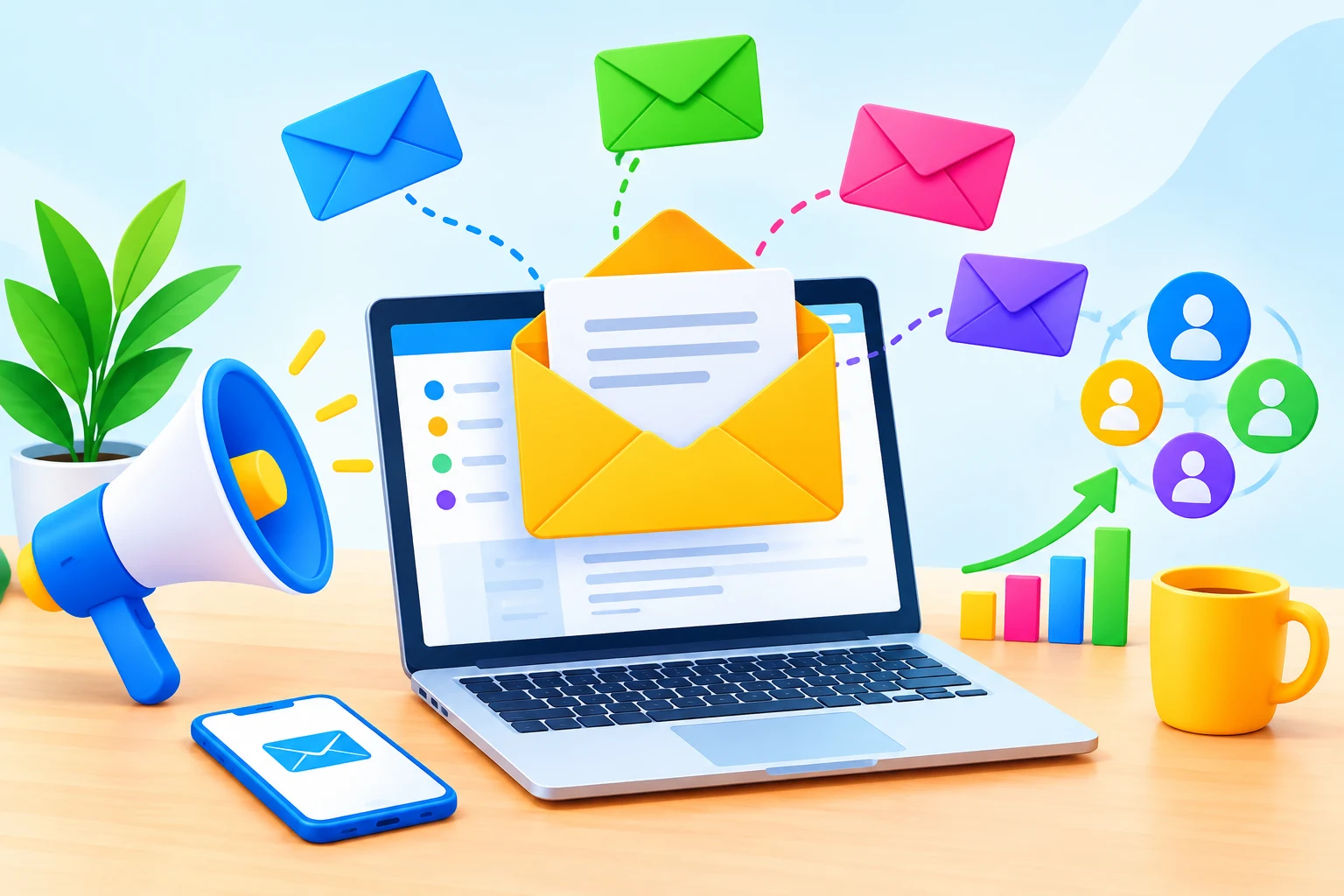
Businesses, organizations, and individuals can use Email marketing to communicate with their audiences through email as part of their digital marketing efforts.. It can be used to introduce a business, share useful information, promote products or services, nurture leads, announce updates, and maintain relationships with existing customers.
Unlike many digital channels where businesses depend on algorithms or advertising platforms to reach people, email provides a direct communication channel. When someone voluntarily subscribes to an email list, the business can communicate with that person through their inbox, subject to applicable privacy, consent, and email marketing requirements.
Email marketing is not simply about sending promotional messages. Effective email marketing is built around relevance, timing, useful information, segmentation, and a clear understanding of what subscribers want to receive.
A well-planned email strategy can support several stages of the customer journey, from the first interaction with a business to purchase, onboarding, repeat business, and long-term customer retention.
What Is Email Marketing?
Email marketing is the use of email to communicate with a group of people for marketing, informational, or relationship-building purposes.
Businesses can send emails to people who have subscribed to newsletters, requested information, purchased products, registered for an account, attended an event, or otherwise provided permission to receive certain communications.
Email marketing can serve many purposes, including:
Building relationships with potential customers
Promoting products and services
Sharing educational content
Announcing new products
Sending special offers
Nurturing leads
Welcoming new subscribers
Supporting customer retention
Requesting feedback
Encouraging repeat purchases
The most effective campaigns usually provide a clear reason for the recipient to open and read the message.
How Email Marketing Works
Although email marketing can become highly sophisticated, the basic process is relatively simple. A business builds an audience, creates useful or relevant messages, sends them to appropriate subscribers, measures the results, and improves future campaigns. A typical process looks like this:
Attract subscribers → Get permission → Segment audience → Create email → Send → Measure → Improve
Each stage matters. A large email list does not automatically produce good results. A smaller list containing people who genuinely want the content may be more valuable than a large list filled with inactive or irrelevant contacts.
Why Email Marketing Matters
Email remains useful because it gives businesses a direct way to communicate with people who have already shown some level of interest. Someone who subscribes to a newsletter has taken an action that can indicate interest. Someone who purchases a product has an established relationship with the business. Someone who requests more information may be closer to making a decision.
This makes email particularly useful for communication after the initial discovery stage. Email marketing can help businesses:
Stay connected with prospects
Educate potential customers
Encourage conversions
Increase repeat purchases
Promote important updates
Build customer relationships
Deliver personalized information
Bring visitors back to a website
Support other marketing channels
It can also help turn one-time website visitors into an audience that a business can continue communicating with appropriately.
Main Types of Email Marketing
Not every email serves the same purpose. Different messages are designed for different stages of the customer relationship.
Welcome Emails
A welcome email is usually sent after someone subscribes, registers, or takes another action that begins an email relationship. A good welcome message can explain:
What the subscriber can expect
How often emails may arrive
What type of content will be shared
Where to find important resources
What the subscriber can do next
The welcome stage is important because the subscriber has recently shown interest in the business.
Newsletter Emails
Newsletters are recurring emails that provide useful information or updates. They might include:
Educational articles
Company updates
Industry information
New content
Tips
Product announcements
Upcoming events
A newsletter does not need to be heavily promotional. In many cases, consistently useful information is what keeps subscribers interested.
Promotional Emails
Promotional emails are designed to encourage a specific commercial action.
Examples include:
Discounts
Seasonal offers
New product announcements
Limited-time promotions
Service packages
Special events
Promotional emails should make the offer easy to understand. The recipient should not have to search through a long message to determine what is being offered or what action to take.
Lead Nurturing Emails
Not every potential customer is ready to purchase immediately. Lead nurturing uses a series of relevant messages to help prospects learn more and move closer to a decision.
For example, someone who downloads a guide might first receive additional educational information about law firm SEO, followed by an explanation of a relevant service, and eventually a clear invitation to speak with the business. The exact sequence depends on the business and the customer's needs.
Abandoned Cart Emails
Ecommerce businesses can use abandoned-cart emails when someone adds products to a shopping cart but does not complete the purchase. Similarly, businesses offering law firm SEO can use follow-up emails to remind potential clients about their services and encourage them to continue the conversation. However, these messages should be designed carefully and should comply with applicable privacy and marketing requirements.
Transactional Emails
Transactional emails are triggered by a specific customer action.
Examples include:
Order confirmations
Receipts
Shipping updates
Account notifications
Password reset messages
Appointment confirmations
Transactional messages primarily serve a functional purpose, although businesses may also use them to provide helpful information where appropriate and permitted.
Re-Engagement Emails
Over time, some subscribers stop opening or interacting with emails. Re-engagement campaigns attempt to determine whether those subscribers still want to receive messages. A campaign might remind inactive subscribers about the value of the newsletter or ask them to confirm their preferences.
If someone no longer wants the emails, respecting that preference is more important than keeping the subscriber count artificially high.
Building an Email List
Email marketing starts with having an audience to communicate with. Businesses can build an email list through legitimate methods such as:
Website signup forms
Newsletter subscriptions
Resource downloads
Event registrations
Account registrations
Product purchases
Consultation requests
Relevant offers
The most important principle is that subscribers should understand what they are signing up for.
Avoid purchasing random email lists simply to increase the number of contacts. Purchased or poorly sourced lists can contain irrelevant addresses, inactive users, spam traps, or people who never agreed to receive messages from the business.
A smaller, permission-based list is usually a healthier foundation for long-term email marketing.
What Makes a Good Email Signup Form?
A signup form should make the decision easy. A visitor should quickly understand:
What they will receive
Why it is useful
How frequently they may receive emails
What information is required
What happens after submitting the form
For example, instead of simply displaying: Subscribe a business could explain the value more clearly:
Get practical marketing tips and new guides delivered to your inbox. The exact wording should match what the subscriber will actually receive. Trust is important. If the signup promise says subscribers will receive one useful newsletter each week, sending several aggressive promotional emails every day can quickly damage that trust.
Email Segmentation
One of the biggest advantages of email marketing is the ability to organize subscribers into meaningful groups. This process is called segmentation. Instead of sending exactly the same message to everyone, businesses can send different content based on relevant characteristics or behavior.
Segmenting by Customer Status
A business might separate:
New subscribers
Potential customers
Existing customers
Repeat customers
Inactive subscribers
Each group may need different communication.
Segmenting by Interest
Subscribers can also be grouped based on topics or products they have expressed interest in. For example, a business selling several categories of products might send information about one category to subscribers who have shown interest in that specific area.
Segmenting by Behavior
Behavioral segmentation can consider actions such as:
Previous purchases
Email interactions
Website activity
Content downloads
Product views
Event registrations
Behavioral information can help make emails more relevant, provided it is collected and used appropriately.
Personalization in Email Marketing
Personalization means adapting an email to make it more relevant to the recipient. The simplest form may be using the recipient's name. More advanced personalization can involve recommending content based on interests, purchase history, or previous interactions.
However, personalization should have a purpose.
Adding a person's first name to an otherwise irrelevant email does not make the message genuinely personalized. Useful personalization focuses on relevance. For example, a potential client interested in law firm SEO might receive information related to improving their firm's search visibility, followed by helpful tips or relevant service information based on their needs.
Email Marketing Automation
Automation allows emails to be sent automatically when certain conditions are met. A basic automated sequence might look like:
Signup → Welcome Email → Educational Email → Product Information → Follow-Up
Automation can also be triggered by actions such as:
Joining a list
Downloading a resource
Making a purchase
Completing a registration
Reaching a particular stage
Becoming inactive
The advantage is consistency. Instead of manually sending every message, the system can deliver appropriate communications based on predefined rules. However, automation should still be monitored. Customer behavior changes, links break, offers expire, and old messages can become outdated.
Email Marketing Customer Journey
Email can support several stages of the customer journey.
Awareness: A subscriber may first encounter a business through a website, social media post, advertisement, search result, or referral. The email signup provides an opportunity to continue the relationship.
Education: Educational emails can answer questions and help subscribers understand a problem or potential solution. This stage is especially useful when customers need time to research before making a decision.
Consideration: At this point, the subscriber may be comparing options. Businesses can provide product details, service explanations, demonstrations, FAQs, case studies, or other useful information.
Conversion: A clear offer and call to action can encourage the subscriber to purchase, book, contact the business, or take another desired action.
Retention: After conversion, email can continue supporting the customer with useful updates, product information, support resources, or relevant offers.
How to Write an Effective Marketing Email
A good email does not need to be extremely long. The message should have a clear purpose.
Start With a Strong Subject Line
The subject line is one of the first things a recipient sees. A useful subject line should accurately communicate what the email contains without misleading the recipient. For example, an email about law firm SEO should clearly indicate what the recipient can expect, whether it shares useful information, highlights a service, or addresses a specific SEO topic. Avoid using exaggerated claims simply to increase opens.
Keep the Opening Relevant
The first few lines should quickly establish why the email is worth reading. If the email promises a useful guide, promotion, update, or answer, make that purpose clear early.
Focus on One Primary Action
An email can contain multiple links, but there should usually be one primary action. For example:
Read the full guide
Book a consultation
View the product
Start a free trial
Complete a purchase
Register for an event
Too many competing calls to action can make the message harder to follow.
Make the Content Easy to Scan
Most people do not read every word of every email.
Use:
Short paragraphs
Descriptive headings
Lists when appropriate
Clear buttons or links
Strong visual hierarchy
The design should support the message rather than distract from it.
Email Marketing and Content Marketing
Email marketing and content marketing can work together naturally. A business can publish a detailed article on its website and then notify subscribers about the new content through email. Likewise, email performance can help identify which topics subscribers find useful.
If educational emails about a particular subject consistently receive strong engagement, that topic may deserve additional website content. This creates a useful relationship:
Content attracts attention → Email builds the relationship → More content supports education → Offers encourage action
Email Marketing and SEO
Email marketing does not directly function as a search ranking system. However, email can indirectly support broader marketing efforts. For example, an email can bring subscribers back to a website to read a new article about law firm SEO. Those visitors may share the content, link to it, reference it elsewhere, or become more familiar with the brand.
Email can therefore support content distribution and audience engagement, while SEO focuses primarily on visibility in search engines. The two strategies serve different purposes but can complement one another.
Email Marketing vs. Social Media Marketing
Aspect | Email Marketing | Social Media Marketing |
Definition | Communicating directly with subscribers through email | Communicating with audiences through social media platforms |
Main Focus | Direct communication and relationship building | Discovery, engagement, and public interaction |
Audience Access | Reaches subscribers who have opted into communication | Depends heavily on the platform and its distribution system |
Visibility | Emails are delivered directly to subscribers, although delivery and inbox placement can vary | Not every follower is guaranteed to see a published post |
Discovery | Less focused on public discovery | Strong for content discovery and reaching new audiences |
Engagement | Supports direct and personalized communication | Supports public engagement, comments, shares, and discussions |
Common Uses | Lead nurturing, customer retention, personalized messaging, recurring communication | Brand awareness, community building, content distribution, discovery |
Personalization | Can support highly personalized messaging and segmented campaigns | Can provide personalized experiences but is more dependent on platform features |
Best For | Nurturing leads, retaining customers, and maintaining direct communication | Building awareness, communities, engagement, and distributing content |
Important Email Marketing Metrics
Measuring performance helps businesses understand whether campaigns are accomplishing their objectives.
Open Rate
Open rate measures the percentage of delivered emails that are recorded as opened. However, open-rate measurement can be affected by privacy features, email clients, tracking methods, and technical limitations. It should therefore not be treated as a perfect measure of audience attention.
Click-Through Rate
Click-through rate measures how many recipients clicked a link or call to action in an email. This can provide useful insight into whether the content encouraged further interaction.
Conversion Rate
Conversion rate measures how many recipients completed the desired action. Depending on the campaign, that might be:
A purchase
A registration
A form submission
A booking
A download
Unsubscribe Rate
The unsubscribe rate indicates how many recipients opted out of future marketing emails. A sudden increase can indicate problems with email frequency, relevance, targeting, or expectations.
Bounce Rate
Email bounce rate measures messages that could not be delivered. A high bounce rate can indicate poor list quality, outdated addresses, or technical delivery problems.
Revenue or Leads Generated
For businesses focused on sales or lead generation, the most important question is often whether email contributes to actual business outcomes. Clicks are useful, but purchases, qualified leads, bookings, and revenue usually provide stronger evidence of business value.
Email Deliverability
Deliverability refers to the ability of emails to reach recipients successfully rather than being rejected or filtered into spam. Several factors can influence deliverability.
These include:
List quality
Sending practices
Subscriber engagement
Email authentication
Complaint rates
Bounce rates
Sending reputation
Message content
Technical configuration
Businesses should use appropriate email authentication and follow applicable requirements for commercial email.
Common Email Marketing Mistakes
Sending Too Many Emails
Even interested subscribers can become frustrated if they receive excessive messages. Email frequency should match the expectations established during signup.
Using Misleading Subject Lines
A subject line should accurately represent the email. Short-term increases in opens are not worth damaging subscriber trust.
Ignoring Mobile Users
Many people read email on mobile devices. Messages should be readable on smaller screens, with buttons and links that are easy to interact with.
Buying Email Lists
Purchased lists can create deliverability, reputation, compliance, and audience-quality problems. Building an audience through legitimate acquisition methods is a safer long-term approach.
Sending the Same Message to Everyone
A single generic message may not be relevant to every subscriber. Segmentation can make communication more useful.
Focusing Only on Sales
If every email asks the recipient to buy something, subscribers may stop paying attention. Useful educational content and relationship-building communication can make promotional messages more effective.
Ignoring Inactive Subscribers
An email list can accumulate inactive contacts over time. Businesses should periodically evaluate engagement and consider appropriate re-engagement or list-cleaning strategies.
How Often Should You Send Marketing Emails?
There is no universal frequency that works for every audience. Some newsletters may be appropriate weekly. Others may work better monthly or at another predictable interval. The correct frequency depends on:
Audience expectations
Content availability
Industry
Customer journey
Type of email
Promotional activity
Consistency is often more important than sending emails simply because a calendar says it is time. If subscribers know what to expect, they are more likely to understand the relationship.
How to Create an Email Marketing Strategy
A successful strategy starts before the first campaign is sent.
Define the Objective
Decide what the email program is intended to accomplish. Possible objectives include:
Generate leads
Increase sales
Educate customers
Promote content
Increase repeat purchases
Improve retention
Announce updates
Identify the Audience: Understand who will receive the messages and what they need. Different audiences may require different content, offers, and communication frequencies.
Choose the Signup Method: Determine how people will join the list and what they will receive after subscribing. Make expectations clear.
Plan Content: Create a content calendar that balances useful information with promotional communication. Content may include educational articles, tips, product information, company updates, customer resources, and relevant offers.
Segment the Audience: Organize subscribers into useful groups when enough information is available to make segmentation meaningful.
Create Automated Sequences: Automate recurring journeys such as welcome messages, onboarding, follow-ups, or appropriate post-purchase communication.
Track Results: Measure performance against the actual business objective. A campaign with many clicks but no meaningful conversions may require a different approach.
Improve Over Time: Test different subject lines, offers, formats, content, timing, and calls to action where appropriate. The goal is continuous improvement rather than finding one perfect email.
Email Marketing for Small Businesses
Email can be particularly useful for small businesses because it provides a way to maintain communication with customers and prospects without requiring a large audience. A small business could start with a simple newsletter and gradually build more sophisticated campaigns, much like using law firm seo services to build a stronger online presence over time.
For example, a local service business might collect newsletter subscribers through its website and send useful maintenance advice, seasonal reminders, educational articles, and relevant service information. A law firm could similarly use email to share helpful legal insights, updates, and educational content while supporting its broader law firm seo services strategy.
The strategy should reflect the actual customer journey rather than copying another company's email schedule.
Email Marketing for Service Businesses
Service businesses can use email to explain complicated services, answer common questions, nurture inquiries, and maintain relationships with existing customers. For example, a professional service provider could send educational content that helps potential clients understand a common problem before inviting them to schedule a conversation.
This approach can be useful when customers need trust and information before taking action. For businesses in regulated or highly sensitive industries, email content should also be reviewed against applicable professional, privacy, advertising, and communication requirements.
Email Marketing Tools
Email marketing platforms can help businesses manage subscribers, create campaigns, automate messages, and analyze performance. Common capabilities include:
Contact management
Signup forms
Email templates
Segmentation
Automation
Analytics
A/B testing
Deliverability monitoring
Unsubscribe management
The right platform depends on the size of the audience, complexity of the campaigns, required integrations, budget, and technical needs. A simple newsletter program does not necessarily require a complicated marketing system.
Email Marketing and Automation
Automation becomes increasingly valuable as an email program grows. Instead of manually sending every message, businesses can create workflows based on subscriber actions.
For example:
New subscriber → Welcome message → Educational content → Relevant offer → Follow-up
Another workflow might look like:
Purchase → Confirmation → Helpful information → Follow-up → Retention message
Automation should make communication more timely and relevant, not simply increase the number of emails being sent.
Frequently Asked Questions
What is email segmentation?
Email segmentation is the process of dividing subscribers into smaller groups based on relevant characteristics, interests, actions, preferences, or customer status. For example, a business might create separate segments for new subscribers, existing customers, inactive users, or people interested in specific products or services.
What is email automation?
Email automation uses predefined rules, triggers, or schedules to send messages automatically when certain actions or conditions occur. For example, an automated email might welcome a new subscriber, remind someone about an abandoned cart, or follow up after a customer makes a purchase.
What is email deliverability?
Email deliverability refers to the ability of emails to successfully reach recipients' inboxes rather than being rejected, blocked, or filtered as unwanted mail. Good deliverability depends on factors such as sender reputation, list quality, authentication, engagement, email content, and responsible sending practices.
Should I buy an email list?
Generally, no. Purchased email lists can create quality, deliverability, reputation, privacy, and compliance problems. The people on these lists may not have agreed to receive your messages, which can result in low engagement, spam complaints, unsubscribes, and potential damage to your sender reputation.
What is the difference between promotional and transactional emails?
Promotional emails are primarily intended to market products, services, content, or special offers. Transactional emails are generally triggered by a customer's specific action and provide information related to a transaction or account activity, such as order confirmations, password resets, receipts, or appointment updates.
Can email marketing help generate leads?
Yes. Businesses can use email marketing to nurture potential customers by sharing useful information, answering common questions, introducing relevant products or services, and encouraging appropriate conversion actions. Consistent communication can help build familiarity and trust while moving interested subscribers closer to becoming customers.
Does email marketing help SEO?
Email marketing does not directly replace or improve SEO rankings, but it can support broader digital marketing efforts. Sharing useful content through email may bring visitors back to your website, increase content exposure, encourage engagement, and help your audience discover valuable pages.
What makes a good marketing email?
A good marketing email is relevant, clear, useful, easy to read, and appropriately targeted. It should have a specific purpose, a compelling subject line, concise messaging, and a clear call to action. Personalization and audience segmentation can also make emails more useful and engaging.
Key Takeaways
Email marketing uses email to communicate with prospects, customers, and subscribers.
It can support awareness, education, conversion, and retention.
A permission-based email list is an important foundation.
Segmentation can make messages more relevant.
Automation can deliver timely communication based on subscriber actions.
Useful content is often more valuable than constant promotion.
Email performance should be measured using meaningful metrics.
Deliverability and list quality are essential.
Email and SEO can support different parts of a broader digital marketing strategy.
Email marketing should continuously evolve based on audience behavior and business results.
Final Thoughts
Email marketing is one of the most direct ways for a business to maintain communication with an interested audience. But sending emails is not the same thing as having an effective email marketing strategy. Successful email marketing begins with permission and trust. From there, businesses can use useful content, thoughtful segmentation, relevant offers, automation, and performance measurement to create better experiences for subscribers.
The strongest email programs do not treat every subscriber exactly the same. They recognize that people have different interests, needs, and positions in the customer journey.
A good strategy also understands that email is part of a larger digital marketing system. Website content, SEO, social media, advertising, customer service, and email can work together to move people from discovery to consideration, conversion, and long-term loyalty.
When businesses focus on relevance instead of volume, email becomes more than a promotional channel. It becomes a long-term communication asset that can help build relationships and support measurable business growth.
Ready to put this to work for your firm?
We'll audit your site for free and show you exactly which pages are costing you cases.
Get a free SEO audit