
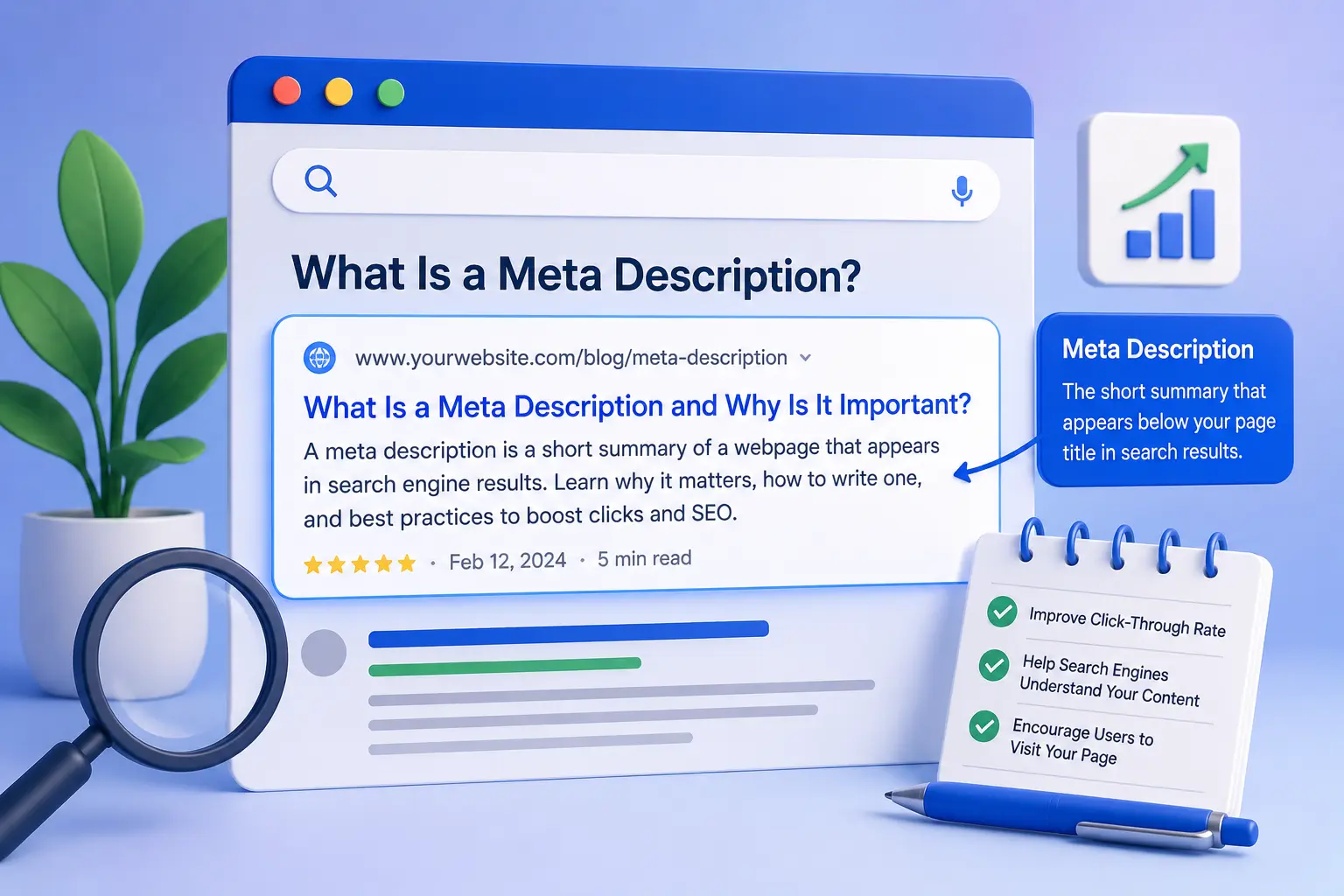
A meta description is a short summary of a webpage that can appear below the page title in search engine results.
It gives searchers an idea of what a webpage is about before they click. For example, if someone searches for law firm SEO services, a search result may display a page title followed by a short description explaining the page's content.
A well-written meta description can help users understand the value of a page and may encourage more qualified clicks. Meta descriptions are therefore an important part of SEO and search result optimization, even though they are not a direct Google ranking factor.
This guide explains what a meta description is, how it works, where it appears, how to write one, ideal length, its relationship with click-through rate, how Google generates snippets, common mistakes, and how law firms can use meta descriptions effectively.
What Is a Meta Description?
A meta description is an HTML attribute that provides a short summary of a webpage. It is placed inside the webpage's <head> section.
A basic example looks like this:
<meta name="description" content="Learn how law firm SEO can improve organic visibility, attract qualified traffic, and generate more potential client opportunities.">
The description tells search engines and users what the page is about.
However, the meta description you write is not guaranteed to be the exact text Google displays in its search results. Google may use the provided description, modify it, or generate a different snippet based on the search query and page content.
Where Does a Meta Description Appear?
Meta descriptions are primarily associated with search engine results pages, often called SERPs.
A typical organic search result may contain:
Page Title
URL or breadcrumb information
Description/snippet
For example:
Law Firm SEO Services | LawFirmSEO
Grow your law firm's organic visibility with SEO strategies designed to improve rankings, attract qualified traffic, and generate more consultations.
The description gives the searcher additional context about the page.
What Does a Meta Description Look Like in HTML?
The standard format is:
<meta name="description" content="Your webpage description goes here.">
The name="description" attribute identifies the meta element as a page description. The content attribute contains the description. This code should normally appear inside the <head> section of the HTML document.
Are Meta Descriptions a Google Ranking Factor?
No. Google has stated that meta descriptions are not a direct ranking factor. This means adding a keyword to your meta description does not directly cause Google to rank the page higher. However, meta descriptions can still be valuable.
A useful description can help searchers understand the result and may influence whether they choose to click it. Therefore, meta descriptions are better viewed as part of search result presentation and click optimization, rather than a direct ranking signal.
Why Are Meta Descriptions Important?
Meta descriptions can help:
Explain what a page offers
Set expectations for visitors
Improve search result clarity
Encourage relevant clicks
Highlight a page's value
Support a strong organic search presentation
A good meta description answers an important question:
"Why should I click this result?"
Meta Description and Click-Through Rate
Click-through rate, or CTR, measures the percentage of users who click a result after seeing it. For example, if 1,000 people see a search result and 50 click it:
CTR = 5%
A compelling meta description may help improve the attractiveness of a search result. However, CTR depends on many factors, including:
Search intent
Position in the results
Title
Description
Brand recognition
Search features
Competition
User expectations
Therefore, a meta description alone does not determine CTR.
What Is an Organic Search Snippet?
A search snippet is the information Google displays about a webpage in search results. It can include:
Page title
URL/breadcrumb
Description
Other search features
The description portion may come from your meta description, but Google can generate its own snippet when it believes another part of the page better matches the user's search.
Does Google Always Use Your Meta Description?
No. This is one of the most important things to understand. You can write a carefully optimized meta description, but Google may choose different text. Google may generate a snippet from the page content when it believes that text is more relevant to the specific search query. For example, your meta description might say:
Learn how law firm SEO can improve organic visibility and attract qualified traffic.
But a user searches: how long does law firm SEO take?
Google may choose a section from the page that directly addresses the time required for SEO instead. This allows the search result to better match the user's query.
Why Does Google Rewrite Meta Descriptions?
Google may rewrite a meta description because the provided description:
Does not accurately describe the page
Is too generic
Does not match the search intent
Does not contain useful information for the query
Is outdated
Is overly promotional
Does not provide enough context
This does not necessarily mean your meta description is technically wrong. Google is simply trying to generate a useful search snippet for the particular query.
Should You Still Write Meta Descriptions?
Yes. Even though Google may rewrite them, providing a clear and useful meta description gives search engines a strong starting point. A good meta description should accurately summarize the page and communicate its value.
Do not skip it simply because Google sometimes generates its own snippet.
How Long Should a Meta Description Be?
There is no fixed character limit that guarantees the entire description will appear in Google. Search snippets can be truncated depending on:
Device
Search query
Screen width
Search result layout
Google's snippet generation
Instead of obsessing over an exact character count, focus on making the most important information appear near the beginning. A practical approach is to keep the description concise enough to communicate the page's main value without unnecessary wording.
What Is the Ideal Meta Description Length?
There is no universal ideal length. Many SEO professionals use descriptions roughly within the range of 150–160 characters as a practical guideline for desktop search. However, this is not a Google requirement. A description can sometimes be displayed longer or shorter.
The priority should be: Clarity + Relevance + Value + Conciseness rather than hitting an exact character number.
Should Meta Descriptions Be the Same Length?
No. Different pages may require different descriptions. A simple service page may need a concise explanation. A comprehensive guide may require a description that highlights its main topics. The description should reflect the actual page.
What Makes a Good Meta Description?
A strong meta description is:
Relevant
Accurate
Specific
Useful
Easy to understand
Written for humans
Related to search intent
Consistent with the page content
It should tell users what they can expect after clicking.
Include the Main Topic Naturally
If your page targets: Law Firm SEO Services, you can naturally include that phrase in the meta description. For example: Discover law firm SEO services designed to improve organic visibility, attract qualified visitors, and help your firm generate more online opportunities. The keyword is included naturally without excessive repetition.
Write for Searchers, Not Search Engines
A meta description should be written primarily for people. Avoid descriptions such as:
Law firm SEO, SEO law firms, best law firm SEO, law firm SEO services, lawyer SEO, attorney SEO. This looks unnatural and provides little value. A better description explains what the page offers.
Match the Search Intent
Search intent should influence the description. For an informational article: Learn what backlinks are, why they matter for SEO, and how links can contribute to a website's organic search visibility. For a service page: Explore law firm SEO services designed to improve search visibility, attract qualified traffic, and support long-term organic growth. The descriptions serve different purposes because the pages serve different intents.
Make the Description Specific
Avoid generic descriptions such as: Welcome to our website. Learn more about our services. This does not tell the searcher anything useful.
Instead, explain:
What the page covers
Who it is for
What benefit it provides
What the visitor can expect
Use a Clear Value Proposition
A value proposition tells the searcher why the page is useful. For example:
Learn how technical SEO can help law firms improve website crawlability, indexing, site structure, and search visibility. This is more informative than: Learn more about technical SEO.
Use a Call to Action When Appropriate
A call to action can encourage users to click. Examples include:
Learn how it works
Explore the guide
Get practical tips
Compare your options
Discover the process
Request an SEO audit
A call to action should fit the page. Do not force "Buy Now" into an informational article.
Meta Description Examples
Informational Page: Learn what keywords are, how search intent works, and how keyword research can support a successful SEO strategy.
Service Page: Explore law firm SEO services designed to improve organic visibility, attract qualified traffic, and support long-term search growth.
Local SEO Page: Learn how local SEO can help law firms improve visibility in local search and connect with potential clients in their target areas.
Technical SEO Page: Discover how technical SEO improves crawlability, indexing, website structure, performance, and search engine accessibility.
Meta Description for a Law Firm Website
Law firm websites often contain different page types. Each page should have a description that accurately reflects its purpose. For example:
Homepage: LawFirmSEO helps law firms improve organic search visibility through focused SEO strategies, technical optimization, content, and local SEO.
Practice Area Page: Learn about our approach to SEO for law firms and how targeted optimization can improve visibility for relevant practice-area searches.
Blog Post: Learn what a meta description is, why it matters in SEO, how Google generates snippets, and how to write better descriptions.
Contact Page: Contact LawFirmSEO to discuss your law firm's SEO goals, website visibility, content strategy, and organic search opportunities.
Each description has a different purpose.
Meta Description vs. Meta Title
These two elements are often confused.
Meta Title: The title generally serves as the primary title displayed in search results and helps communicate the page's topic.
Meta Description: The description provides additional context about the page and can encourage users to click.
Example: Title: Law Firm SEO Services | LawFirmSEO
Description: Improve your law firm's organic visibility with a focused SEO strategy covering technical SEO, content, local search, and website optimization.
The title identifies the result. The description explains it.
Meta Description vs. SEO Title
In many SEO platforms, you may see terms such as:
SEO title
Meta title
Title tag
These generally refer to the HTML title element used for the page title. A meta description is a separate HTML element.
Meta Description vs. Search Snippet
A meta description is content you provide in your webpage's HTML. A search snippet is the text Google chooses to display in the search result. Your meta description can become the snippet, but Google may replace it.
Therefore:
Meta description ≠ guaranteed search snippet
Meta Description vs. Featured Snippet
These are completely different concepts. A meta description is metadata associated with a webpage. A featured snippet is a search result format that may display an answer from a webpage prominently in Google's search results. Having a meta description does not guarantee a featured snippet.
Meta Descriptions and Keywords
Including a relevant keyword can be useful because it may help the searcher immediately recognize that your page addresses their query. Google may also bold matching words in search snippets. However, keyword repetition should be avoided. For example: Law firm SEO services for law firms. Get law firm SEO from our law firm SEO agency. is poor writing.
A better version is: Explore SEO services designed specifically for law firms, including technical SEO, content optimization, local search, and website improvements.
Should Every Meta Description Include the Exact Keyword?
No. The description should accurately communicate the page's subject. If the exact keyword fits naturally, use it. If it does not, do not force it. Search engines understand related language and concepts.
Unique Meta Descriptions for Every Page
Ideally, important pages should have unique meta descriptions. For example, these pages should not all use: Learn more about our law firm SEO services.
Instead, create descriptions specific to:
Homepage
Service pages
Practice pages
Location pages
Blog posts
Resources
Contact pages
Unique descriptions make it easier for searchers to understand what each result offers.
What Happens When Multiple Pages Have the Same Meta Description?
Duplicate meta descriptions are not automatically a ranking penalty. However, they can make search results less descriptive and less useful. If a website has hundreds of pages using the same description, searchers may have difficulty understanding how the pages differ.
For large websites, creating unique descriptions for the most important pages should generally be prioritized.
Meta Descriptions for Blog Posts
Blog meta descriptions should summarize the actual article. For example, an article titled:
What Are Backlinks? could use:
Learn what backlinks are, how they work, why they matter for SEO, and what makes a backlink valuable. This tells the reader exactly what the article covers.
Meta Descriptions for Service Pages
Service-page descriptions should communicate:
The service
The audience
The benefit
The value
Example: Discover law firm SEO services focused on technical optimization, content, local visibility, and long-term organic search growth.
Meta Descriptions for Location Pages
Location pages can mention the relevant geographic area when appropriate. Example: Explore SEO services for law firms in Miami, focused on improving local visibility, organic rankings, website performance, and qualified search traffic. The location should be genuine and relevant to the page.
Meta Descriptions and Local SEO
Meta descriptions can support local search presentation by clearly communicating:
Business type
Service
Location
However, meta descriptions alone do not determine local rankings. Local SEO also involves factors such as:
Google Business Profile
Local relevance
Website content
Reviews
Citations
Links
Business information
Searcher location
Meta Descriptions and Mobile Search
A significant amount of search activity occurs on mobile devices. Mobile search results may display less text depending on the screen size and result layout. This is another reason to put the most important information toward the beginning of the description.
Meta Descriptions and Desktop Search
Desktop screens can sometimes display more text than mobile screens. However, the amount shown can vary. Do not write a description assuming that every character will always be displayed.
Can Meta Descriptions Improve Rankings?
Not directly. Meta descriptions are not considered a direct Google ranking factor. Their value is primarily related to communicating what a page is about and potentially improving the attractiveness and relevance of the search result. Better search-result presentation can contribute to more qualified clicks, but rankings involve many other factors.
Can Meta Descriptions Increase Traffic?
They can potentially contribute to more clicks when they make a search result more compelling and relevant. For example, suppose two pages rank for the same query. One has: Welcome to our website. We provide many services.
The other has: Learn how technical SEO can improve your law firm's crawlability, indexing, site structure, and search visibility.
The second description gives the searcher much more useful information. However, traffic depends on ranking position, search demand, intent, competition, and many other factors.
How to Write a Meta Description Step by Step
Writing an effective meta description is about more than adding keywords. It should accurately summarize the page, match the user's search intent, and encourage people to click while setting the right expectations.
Step 1: Identify the Page's Purpose
Start by identifying the primary purpose of the page. Ask yourself, "What is this page about?" and determine the main topic or message you want visitors to understand before they click.
Step 2: Understand the Search Intent
Consider why someone would search for this page and what they expect to find. Whether the intent is informational, commercial, or transactional, your meta description should reflect those expectations.
Step 3: Identify the Main Value
Determine the most valuable takeaway for the reader. Highlight what users will learn, solve, or achieve after visiting the page so they immediately understand its relevance.
Step 4: Write a Clear Summary
Write a concise, natural-language summary that accurately describes the page's content. Focus on clarity and usefulness rather than trying to include as many keywords as possible.
Step 5: Include Relevant Terms
Naturally incorporate your primary keyword and closely related terms where they fit. Relevant keywords help reinforce the page's topic without making the description sound repetitive or forced.
Step 6: Add a Call to Action
When appropriate, include a simple call to action that encourages users to learn more or take the next step. Use language that fits the page's purpose instead of adding promotional phrases to every description.
Step 7: Keep It Concise
Remove unnecessary words and focus on the most important information. A concise, well-written description is easier for users to read and more likely to display effectively in search results.
Step 8: Check Accuracy
Review the description to ensure it accurately represents the page's content. Misleading descriptions can increase bounce rates and create a poor experience for users who expected something different.
Step 9: Make It Unique
Write a unique meta description for every important page on your website. Distinct descriptions help users differentiate pages in search results and reduce the likelihood of duplicate metadata.
Step 10: Monitor Search Performance
Review your page performance using Google Search Console to monitor impressions, clicks, and click-through rates. Update your meta descriptions when user behavior, search intent, or page content changes to keep them relevant and effective.
How to Write Meta Descriptions for Law Firm SEO Pages
A useful formula is: Service + Audience + Benefit + Action
For example: Discover SEO services for law firms designed to improve organic visibility, attract qualified search traffic, and support long-term growth. Another formula for informational content is: Topic + Key Questions + Benefit For example: Learn what keyword research is, how it works, and how law firms can use search data to build a stronger SEO strategy.
Common Meta Description Mistakes
Mistake 1: Keyword Stuffing
Repeating the same keywords multiple times makes a meta description sound unnatural and difficult to read. Instead, write a clear, compelling description that naturally includes the primary keyword while accurately summarizing the page's content.
Mistake 2: Writing Generic Descriptions
Generic descriptions such as "Welcome to our website" or "Learn more here" provide little value to users. A good meta description should clearly explain what the page offers and why someone should click on it.
Mistake 3: Using the Same Description Everywhere
Each important page should have a unique meta description that reflects its specific content and purpose. Reusing the same description across multiple pages makes it harder for users and search engines to distinguish between them.
Mistake 4: Misrepresenting the Page
Your meta description should accurately describe what visitors will find after clicking. Promising information or services that the page does not actually provide can increase bounce rates and reduce user trust.
Mistake 5: Writing Only for Search Engines
Meta descriptions should be written for people, not just search engines. Focus on creating concise, informative copy that encourages users to click while accurately representing the page's content.
Mistake 6: Focusing Too Much on Character Count
While it's helpful to keep descriptions concise, there is no fixed character limit that guarantees Google will display the entire snippet. Prioritize writing a clear, informative description instead of obsessing over an exact length.
Mistake 7: Ignoring Search Intent
A strong meta description should match the intent behind the user's search. Whether the query is informational, commercial, or transactional, the description should clearly communicate how the page satisfies that need.
Mistake 8: Making Every Description Promotional
Not every page should use aggressive marketing language. Informational pages should focus on explaining what readers will learn, while service or product pages can emphasize benefits and encourage action where appropriate.
Mistake 9: Stuffing Locations
Adding long lists of cities or locations solely to influence local search creates poor-quality metadata. Include location names only when they are genuinely relevant to the page and provide meaningful context for users.
Mistake 10: Assuming Google Must Use Your Description
Google may rewrite or replace your meta description with a different snippet from the page if it believes another section better matches the user's search query. Even so, writing high-quality meta descriptions remains an SEO best practice.
How to Audit Meta Descriptions
A meta description audit can identify:
Missing descriptions
Duplicate descriptions
Very short descriptions
Very generic descriptions
Irrelevant descriptions
Descriptions that do not match page content
SEO crawling tools can help identify these issues across larger websites. For a small law firm website, manually reviewing the most important pages can also be effective.
What Pages Need Meta Descriptions?
Most indexable HTML pages can have meta descriptions. Prioritize:
Homepage
Main service pages
Practice-area pages
Location pages
Important blog posts
Resource pages
Commercial landing pages
You do not necessarily need to spend equal effort on every low-value page.
What If a Page Has No Meta Description?
If a page does not have a meta description, Google may generate a snippet from the page's content. This does not automatically prevent the page from ranking. However, writing a useful description gives you an opportunity to provide a better summary of the page.
Meta Descriptions in WordPress
If your website uses WordPress, SEO plugins commonly provide fields for editing meta titles and descriptions.
Popular SEO plugins may include tools for:
Meta descriptions
Title tags
XML sitemaps
Canonicals
Robots directives
The exact interface depends on the plugin you use. The important part is ensuring the final HTML contains the intended metadata.
How to Check a Meta Description
You can inspect a webpage's HTML source and search for: <meta name="description"> You can also use SEO crawling tools to audit descriptions across a website.
Meta Descriptions and Structured Data
Meta descriptions and structured data are different. A meta description summarizes a webpage. Structured data provides machine-readable information about the content and entities on a page. Structured data can help search engines understand specific types of content and may support eligibility for certain search result features. One does not replace the other.
Meta Descriptions and AI Search
Search experiences are increasingly capable of generating summaries from webpage content. This makes it even more important for the underlying page to clearly communicate its topic and provide useful information. A well-written meta description remains valuable for traditional search results, but SEO should not depend on metadata alone.
The page itself needs to be comprehensive, accurate, accessible, and useful.
How Often Should You Update Meta Descriptions?
There is no fixed schedule. Consider reviewing them when:
The page content changes significantly
Search intent changes
A page's title changes
The service changes
The target audience changes
Search performance suggests an opportunity
A description is outdated
Do not change successful descriptions unnecessarily.
How to Test Meta Descriptions
You can compare performance over time by monitoring:
Impressions
Clicks
CTR
Average position
Search queries
Google Search Console can help you evaluate these metrics. Keep in mind that many factors change simultaneously, so an increase or decrease in CTR cannot always be attributed solely to a meta description.
Frequently Asked Questions
Should every page have a unique meta description?
Yes. Every important page should ideally have a unique meta description that accurately summarizes its content. Unique descriptions help users understand what each page offers and make it easier for search engines to distinguish between similar pages.
Should I include keywords in my meta description?
Yes. Include your primary keyword naturally when it fits the context and accurately describes the page. Avoid keyword stuffing, as meta descriptions should be written primarily for users while clearly communicating the page's topic.
Can meta descriptions improve Google rankings?
Not directly. Meta descriptions are not a confirmed Google ranking factor. However, a well-written description can encourage more users to click your result, which may improve your overall search performance and visibility.
Why does Google rewrite my meta description?
Google may generate a different search snippet if it believes another section of your page better matches the user's search query. This is normal and does not necessarily indicate a problem with your original meta description.
What is the difference between a meta description and a title tag?
A title tag is the primary headline displayed in search results and helps describe the page's main topic. A meta description provides additional context by summarizing the page and encouraging users to click through to your website.
What happens if my page has no meta description?
If no meta description is provided, Google may automatically generate a snippet from the page's content. While this can still produce a relevant result, writing your own description gives search engines a clearer summary of the page.
Can meta descriptions help local SEO?
Yes. Although meta descriptions are not a direct local ranking factor, they can clearly communicate your services, locations, and value to searchers. This can make your listing more relevant and encourage qualified users to click.
Should service pages have meta descriptions?
Yes. Every service page should include a unique meta description that explains the service offered, who it is for, and why users should visit the page. Clear descriptions help improve relevance and user engagement in search results.
Should I put a call to action in every meta description?
Not necessarily. A call to action can be effective when it naturally fits the page and search intent, but informational pages often perform better with a clear summary of what readers will learn rather than promotional language.
Are meta descriptions important for law firm websites?
Yes. Meta descriptions help law firms communicate their legal services, practice areas, locations, and the value of each page in search results. Well-written descriptions can attract more qualified visitors by setting clear expectations before users click.
Key Takeaways
A meta description is a short piece of HTML metadata that summarizes a webpage. It can appear as the description in Google's search results, although Google may choose to generate a different snippet.
The most important principles are:
Write for people
Describe the actual page
Match search intent
Keep the description concise
Use relevant keywords naturally
Make important pages unique
Avoid keyword stuffing
Put important information early
Do not rely on a specific character limit
Remember that Google can rewrite the snippet
For law firm websites, meta descriptions should clearly communicate what each page offers and why the searcher should consider clicking. A good meta description does not need to manipulate search engines. It needs to help the right searcher understand the right page at the right moment.
Improve Your Law Firm's Search Result Presentation
Meta descriptions are only one part of a successful SEO strategy. A law firm's search visibility also depends on technical SEO, content quality, website architecture, internal linking, local SEO, authority, and the overall usefulness of its website.
SEO strategies can combine on-page optimization, technical SEO, content strategy, local SEO, keyword research, and website improvements to help law firms build stronger organic search visibility.
Ready to put this to work for your firm?
We'll audit your site for free and show you exactly which pages are costing you cases.
Get a free SEO audit