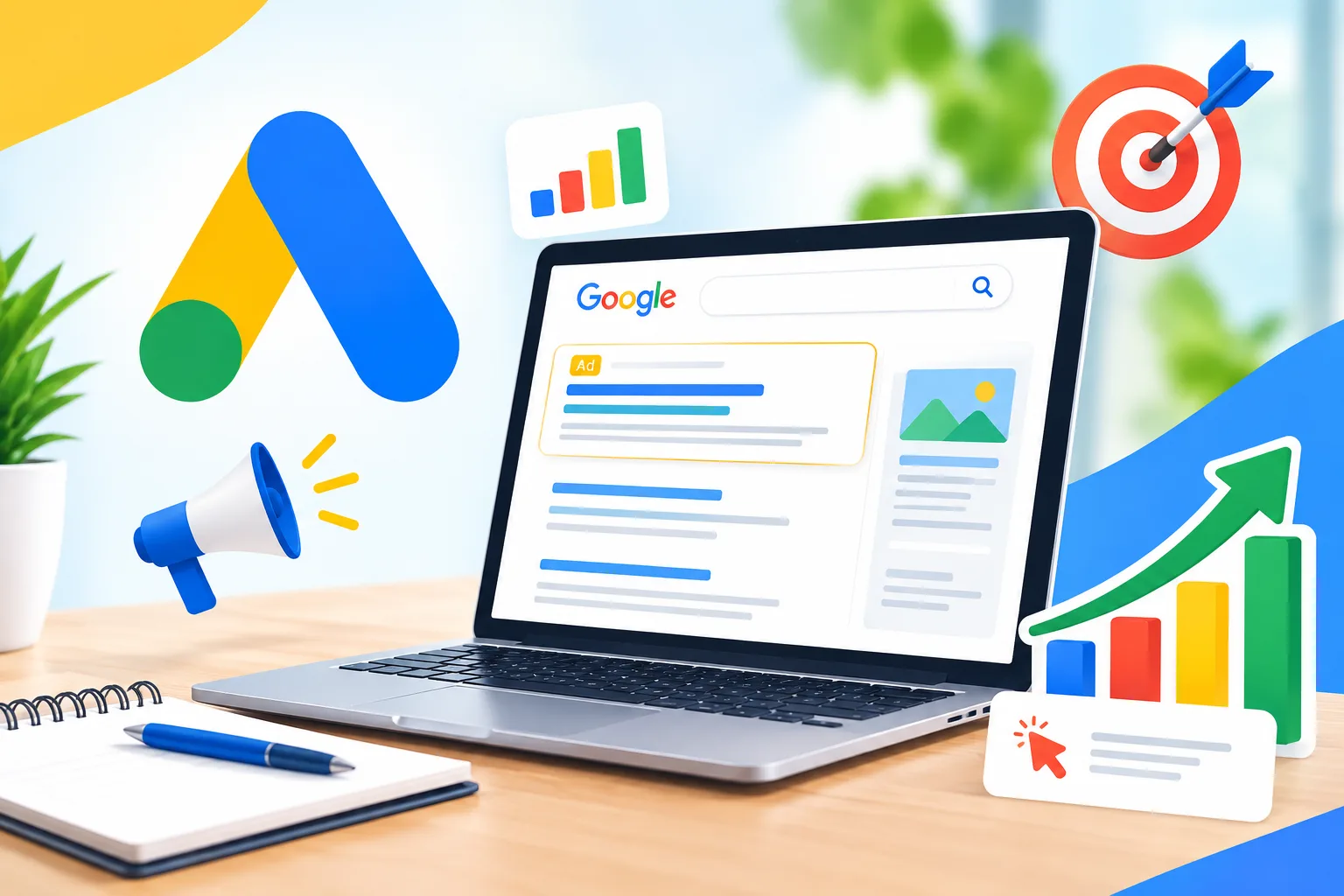
An online advertising platform, Google Ads allows businesses to promote their products, services, websites, and offers to people searching for relevant information or browsing content across Google's advertising network. Instead of waiting for people to discover a business through organic search, companies can use paid advertising to place their message in front of potential customers.
Google Ads can be useful for businesses of many sizes because campaigns can be targeted by factors such as keywords, location, audience, device, and other signals. However, getting traffic is only one part of successful advertising. A profitable Google Ads campaign also depends on choosing the right searches, writing useful advertisements, controlling costs, creating relevant landing pages, and measuring what happens after the click.
What Is Google Ads?
Google Ads is Google's paid advertising system. Businesses create advertisements and choose how and where they want those advertisements to appear. Depending on the campaign, ads can appear when people search on Google, watch videos, browse websites, use apps, or interact with other Google-supported properties.
The most familiar form is the paid search advertisement that appears when someone searches for a product or service. These advertisements are designed to match the user's search and usually include a headline, description, and destination URL.
Google Ads is commonly associated with pay-per-click advertising, although not every Google advertising campaign operates in exactly the same way. In a typical search campaign, an advertiser pays when someone clicks an advertisement rather than simply because the advertisement was displayed.
The important idea is simple: Google Ads gives businesses an opportunity to reach potential customers at moments when their interests or needs may already be clear.
How Google Ads Works
Google Ads may look simple from the user's perspective, but several processes happen behind the scenes when an advertisement is displayed.
Imagine that someone searches for “law firm seo services.” Multiple businesses may want their advertisements to appear for that search. Google determines which eligible advertisements can participate and how they should be positioned based on factors such as the advertiser's bid, ad quality, relevance, and other auction-related signals.
The advertiser does not simply pay the highest amount and automatically receive the top position.
Google's advertising system evaluates eligible ads through an auction. The result can change depending on the search, competition, targeting settings, ad quality, and other circumstances.
Search for a Keyword
A user enters a search query into Google. The advertiser may have selected keywords that are relevant to that search. Depending on the campaign's keyword and matching settings, the advertisement may become eligible to participate.
For example, an advertiser targeting searches related to “law firm seo” may want to reach businesses dealing with flooding, leaks, or other urgent property problems.
Advertisers Enter an Auction
When advertisements are eligible to appear, they can enter an advertising auction. The auction considers more than the advertiser's maximum bid. Relevance and the expected usefulness of the advertisement and landing page can also influence how an ad performs. This is one reason simply increasing the budget does not automatically solve every Google Ads problem.
Ads Are Ranked
Google determines which eligible advertisements appear and in what order. An advertiser with a large budget can still struggle if the targeting is poor, the advertisement does not match the search intent, or the landing page provides a weak experience.
A smaller business can sometimes compete effectively by focusing on highly relevant searches and creating a strong overall advertising experience.
The User Sees Relevant Ads
The user sees advertisements that Google determines are eligible and relevant to the search or context.
If the advertisement addresses the user's need, the person may click it. The advertiser then has an opportunity to turn that visit into a lead, sale, booking, phone call, or another desired action.
Why Google Ads Matters
One major advantage of Google Ads is the ability to reach people based on active demand. A person searching for law firm SEO services is different from someone casually reading an article about search engine optimization. The search itself can provide a strong indication that the person has a current need.
This makes search advertising particularly useful for products and services where people actively search before making a decision. Google Ads can help businesses:
Generate targeted website traffic
Reach customers in specific geographic areas
Promote particular products or services
Generate phone calls and form submissions
Test demand for an offer
Support seasonal promotions
Reach potential customers before competitors
Measure advertising performance more directly
However, advertising should not be judged only by the amount of traffic it produces. A campaign receiving thousands of clicks may still perform poorly if those visitors do not become customers.
Main Types of Google Ads
Google Ads supports different advertising formats and campaign approaches. Each one can serve a different marketing purpose.
Search Ads
Search ads are text-based advertisements that can appear when people search for relevant terms. They are especially useful when someone is actively looking for a product, service, solution, or business.
For example, a law firm SEO campaign might target searches related to:
Law firm SEO services
SEO for law firms
Local SEO for law firms
Law firm SEO agency
SEO services for attorneys
Search advertising is often strongest when the advertiser understands the user's intent rather than simply targeting a large collection of keywords.
Display Ads
Display advertising can place visual advertisements across law firm agency websites and other digital environments that participate in Google's advertising network. These ads can be useful for awareness, remarketing, and reaching audiences while they browse content rather than actively searching for a particular service.
Shopping Ads
Shopping advertising is designed around products and product information. Depending on the campaign and eligibility, users can see product imagery, pricing, and other product details. This format can be particularly useful for businesses selling physical products online because the advertisement can provide more information before the visitor reaches the website.
Video Ads
Video advertising allows businesses to promote messages through video placements. Video can be useful for demonstrating products, explaining services, introducing a company, showing customer experiences, or building awareness.
The challenge is that a video advertisement must capture attention quickly. A technically impressive video can still perform poorly if viewers do not understand the message or value proposition.
App Ads
Businesses promoting mobile applications can use advertising designed to help drive app-related actions, such as installations or engagement. The campaign objective should determine whether the focus is primarily on acquiring new users, encouraging existing users to return, or supporting another measurable app action.
Automated Multi-Channel Campaigns
Google also offers campaign approaches that can distribute advertising across multiple Google-supported surfaces using automated optimization. These campaigns can use Google's systems to help determine where and when advertisements may perform best based on the advertiser's goals and available signals.
Because automation can influence targeting, bidding, and placement decisions, advertisers still need strong goals, accurate conversion measurement, appropriate assets, and ongoing performance analysis.
Google Ads vs SEO
Google Ads and SEO can both help a website gain visibility in search results, but they work differently. With Google Ads, a business pays for advertising opportunities and can often begin generating traffic shortly after campaigns are launched and approved.
SEO focuses on improving a website's ability to appear in organic search results without paying for each organic click.
The difference is not simply “paid versus free.” SEO requires investment in content, technical improvements, authority, research, and ongoing optimization. Google Ads requires advertising spend and careful campaign management.
Google Ads | SEO |
Paid advertising | Organic search visibility |
Can generate traffic quickly after launch | Usually takes longer to build |
Budget controls paid traffic opportunities | Traffic depends on organic rankings and demand |
Useful for testing offers and keywords | Useful for building long-term search visibility |
Requires ongoing ad spend | Requires ongoing optimization and content investment |
For many businesses, the strongest strategy is not choosing one forever. Paid and organic search can support different stages of the marketing strategy.
Google Ads vs PPC
Google Ads and PPC are often used as if they mean exactly the same thing, but they are not identical terms.
PPC, or pay-per-click, describes an advertising model where the advertiser generally pays when someone clicks an advertisement.
Google Ads is a specific advertising platform operated by Google.
In other words, Google Ads can be used for PPC advertising, but PPC advertising can also exist on other advertising platforms.
This distinction becomes useful when discussing digital marketing strategies. PPC is the broader advertising model, while Google Ads is one major platform where that model can be used.
How Google Ads Bidding Works
Bidding is one of the most important parts of Google Ads because it influences how an advertiser competes for available advertising opportunities.
However, bidding should not be treated as simply choosing the highest possible amount. The appropriate bidding approach depends on the campaign objective, available conversion data, competition, budget, and business economics.
Manual and Automated Bidding
Some advertising strategies give advertisers greater direct control over bids, while automated approaches allow Google's systems to adjust bids based on the selected objective and available signals.
Automation can save time and help process large amounts of information, but it does not eliminate the need for strategy. If the campaign is tracking the wrong conversion, automation can optimize toward the wrong outcome.
Cost Per Click
Cost per click, commonly called CPC, represents how much an advertiser pays for a click. For example, if a campaign spends $100 and receives 50 clicks, the average CPC is:
$100 ÷ 50 = $2 per click
The actual cost of individual clicks can vary. A low CPC is not automatically good. If inexpensive clicks never produce customers, they may be less valuable than more expensive clicks that consistently generate profitable leads.
Cost Per Conversion
Cost per conversion measures how much advertising spend is required to generate a desired conversion. For example, if a campaign spends $500 and generates 25 qualified leads, the cost per lead is:
$500 ÷ 25 = $20 per lead
This metric is usually more meaningful for lead-generation businesses than CPC alone.
Conversion Value
Some businesses can assign monetary values to conversions. For example, with law firm SEO, a law firm may estimate the value of a qualified consultation request, phone call, or new client generated through organic search. Understanding conversion value makes it easier to evaluate whether SEO efforts are producing economically useful results.
Understanding Keywords in Google Ads
Keywords help advertisers communicate which searches may be relevant to their advertisements. Keyword strategy is more complicated than simply finding popular phrases.
A good keyword can have enough demand to produce opportunities while also matching what the business actually sells.
Broad Match
Broad matching can allow advertisements to reach a wider range of searches related to the selected keyword. The advantage is greater potential reach. The disadvantage is that broader targeting can expose advertisements to searches that are less valuable if the campaign is not properly controlled and monitored.
Phrase Match
Phrase matching provides a more controlled approach than broad matching while still allowing advertisements to reach searches with related wording and intent. It can be useful when advertisers want a balance between reach and relevance.
Exact Match
Exact matching provides tighter control around the searches that can trigger an advertisement. Even then, advertisers should understand that matching systems may consider close variations and intent rather than treating keywords as simple character-for-character rules.
Negative Keywords
Negative keywords tell Google which searches an advertiser does not want to target. This can prevent advertising budget from being spent on irrelevant searches.
For example, a law firm SEO campaign might exclude searches containing terms such as “free,” “jobs,” “salary,” “course,” or “training” if those searches are not relevant to someone looking for SEO services for a law firm.
Negative keyword management can become an important part of maintaining campaign efficiency.
Search Intent and Google Ads
Search intent describes what a person is trying to accomplish with a search. Consider these searches:
“what is law firm SEO”
“law firm SEO checklist”
“law firm SEO company near me”
“hire law firm SEO services”
They are related, but the intent is different. The first may represent research. The last may indicate strong commercial intent. A successful Google Ads campaign considers these differences rather than treating every related keyword as equally valuable.
The advertisement should match the searcher's likely objective. The landing page should continue that same experience. When the keyword, advertisement, and landing page all address the same need, the user has less reason to leave immediately.
How to Create a Google Ads Campaign
Creating a campaign involves more than writing an advertisement and choosing a budget. The structure should begin with the business objective.
Define the Goal
Start by deciding what the campaign needs to accomplish. Possible goals include:
Generate leads
Increase online sales
Generate phone calls
Promote a service
Drive bookings
Increase product awareness
Encourage a specific website action
A clear goal makes later decisions easier.
Choose the Audience and Location
Decide who should see the advertisements and where those potential customers are located. A local business serving one city does not necessarily need to advertise across an entire country. Geographic targeting can help businesses concentrate spending where they can actually provide their products or services.
Research Keywords
Research the searches that potential customers may use. Look beyond search volume. Consider:
Commercial intent
Relevance
Competition
Expected customer value
Service availability
Geographic relevance
A smaller group of highly relevant keywords can sometimes be more useful than a massive list of loosely related terms.
Create Ad Groups or Campaign Structure
Organize related keywords and advertisements logically. The goal is to make the relationship between the search, advertisement, and landing page as clear as possible. Poor structure can make it harder to understand performance and can lead to generic advertisements that fail to address specific user needs.
Write Relevant Ads
The advertisement should communicate why the user should choose the business. Strong ad messaging often includes:
A clear service or product
A relevant benefit
A useful differentiator
A clear call to action
Avoid making claims that cannot be supported.
Create Landing Pages
The landing page is where the visitor goes after clicking. It should provide a natural continuation of the advertisement.
If the advertisement promotes emergency plumbing services, sending the visitor to a generic homepage may create unnecessary friction. A dedicated emergency plumbing page may be more relevant.
Set Budget and Bidding
Determine how much the business can reasonably spend. The budget should be connected to customer economics rather than chosen randomly. If a business earns significant profit from a qualified customer, it may be able to spend more to acquire that customer than a business with a very small profit margin.
Add Conversion Tracking
Conversion tracking helps determine what happens after someone clicks. Depending on the business, conversions might include:
Form submissions
Phone calls
Purchases
Bookings
Account registrations
Quote requests
Downloads
Other valuable actions
Without reliable conversion tracking, it becomes much harder to distinguish useful traffic from wasted spend.
Launch and Monitor
Launching a campaign is the beginning rather than the end. Performance should be reviewed regularly to identify:
Irrelevant searches
Expensive keywords
Strong-performing searches
Poor advertisements
Landing-page problems
Geographic performance differences
Conversion trends
The campaign can then be refined based on evidence.
Writing Effective Google Ads
A successful advertisement does not need to sound complicated. It needs to be relevant and useful. The user should quickly understand what is being offered and why the offer may be worth considering.
Match the Search Intent
The advertisement should reflect what the person searched for. If the search is highly specific but the advertisement is extremely general, the connection may be weak. Specific searches often deserve specific messaging.
Communicate a Clear Benefit
People generally want to know what they will gain. Instead of filling the advertisement with generic statements, focus on a useful benefit. For example, a law firm SEO advertisement might emphasize improved search visibility, more qualified leads, local search optimization, or a clear consultation process.
Use Strong Calls to Action
A call to action tells the user what to do next. Examples include:
Request a Quote
Book a Consultation
Schedule Service
Shop Now
Learn More
Get Started
Contact Us
The call to action should match the actual next step available on the landing page.
Make the Ad Specific
Specific messaging can make an advertisement more compelling. Instead of saying that a business provides “great service,” communicate something more meaningful and verifiable about the service, process, availability, product, or customer experience.
Specificity helps users decide whether the advertisement is relevant to them.
Landing Pages and Google Ads
A Google Ads campaign does not end when someone clicks. The landing page has a major influence on whether the visitor continues toward conversion. A strong landing page should answer the visitor's most important questions without making them search through unrelated information.
For many campaigns, useful landing-page elements include:
A headline matching the advertisement
A clear explanation of the offer
Important benefits
Relevant supporting information
Trust-building elements
A visible call to action
Simple contact or purchase options
Mobile-friendly design
Sending every advertisement to the homepage can create a disconnected experience. A visitor who searches for one specific service should ideally reach a page that addresses that service directly.
Google Ads Quality and Relevance
Advertising performance is influenced by the overall quality and relevance of the experience. Think of the campaign as a chain:
Search → Advertisement → Landing Page → Conversion
If one part is weak, the entire process can suffer. A highly relevant advertisement may attract a click, but if the landing page is slow, confusing, unrelated, or difficult to use, the business may still lose the potential customer.
This is why improving Google Ads performance often requires work outside the advertising interface itself.
Google Ads Budget
There is no single Google Ads budget that works for every business. A reasonable budget depends on factors such as:
Industry
Customer value
Competition
Geographic market
Search demand
Conversion rate
Profit margin
Campaign objectives
A small local business may begin with a controlled budget focused on a limited service area. A national company may require a significantly larger advertising investment.
The important question is not simply: “How much should I spend?”
A better question is: “How much can I profitably spend to acquire a customer?”
That requires understanding conversion rates, lead quality, customer value, and actual revenue.
Important Google Ads Metrics
Metrics help advertisers understand whether campaigns are moving toward their business goals.
Impressions
Impressions represent how often advertisements are shown. A high number of impressions can indicate strong visibility, but impressions alone do not demonstrate business success.
Clicks
Clicks show how many times users interacted with the advertisements. Clicks are useful for understanding traffic generation, but they should not be treated as the final objective for most campaigns.
Click-Through Rate
Click-through rate, or CTR, measures the percentage of impressions that resulted in clicks. A simple calculation is:
CTR = Clicks ÷ Impressions × 100
For example, 50 clicks from 1,000 impressions would produce a 5% CTR.
Average CPC
Average CPC shows the average amount paid for each click. It helps advertisers understand traffic costs, but it should be evaluated alongside conversion and revenue data.
Conversion Rate
Conversion rate measures the percentage of relevant interactions that result in a tracked conversion. A campaign can have a strong CTR but a poor conversion rate if the landing page or offer fails to meet expectations.
Cost per Conversion
Cost per conversion shows how much advertising spend is associated with each conversion. This is especially important for lead-generation campaigns.
Impression Share
Impression share provides insight into how often advertisements are appearing compared with eligible opportunities. Low impression share can have different causes, including budget limitations or other campaign constraints.
Return on Ad Spend
Return on ad spend, commonly called ROAS, compares advertising revenue with advertising spend. For example, if a campaign spends $1,000 and generates $4,000 in tracked revenue:
ROAS = $4,000 ÷ $1,000 = 4
That represents $4 in tracked revenue for every $1 spent on advertising. ROAS is useful for businesses where revenue can be measured reliably, although profitability requires considering other costs as well.
Common Google Ads Mistakes
Even well-funded campaigns can waste money when the fundamentals are ignored.
Choosing Broad Keywords Without Control: Broad targeting can create additional reach, but it can also expose advertisements to searches that do not represent valuable customers. Search-term analysis and campaign refinement are important.
Ignoring Negative Keywords: Without appropriate exclusions, advertisers may continue paying for irrelevant searches. Reviewing actual search behavior can reveal terms that should be excluded.
Sending All Traffic to the Homepage: The homepage is not always the best destination. A dedicated landing page can provide a more relevant experience for visitors searching for a specific product or service.
Poor Conversion Tracking: If conversions are not tracked correctly, campaign decisions can become misleading. An advertiser may increase spending on traffic that looks good in reports but produces little actual business value.
Weak Ad-to-Landing-Page Relevance: If the advertisement promises one thing and the landing page focuses on something else, users may leave. The message should remain consistent from the search through the conversion process.
Changing Campaigns Too Frequently: Constantly changing bids, targeting, keywords, advertisements, and settings can make performance difficult to interpret. Optimization should be based on meaningful evidence rather than reacting to every small fluctuation.
Focusing Only on Clicks: Clicks are not customers. A campaign that generates fewer clicks but more qualified leads can be significantly more valuable than one that generates large amounts of inexpensive traffic.
Google Ads for Small Businesses
Small businesses can use Google Ads to compete for targeted searches without necessarily advertising everywhere. A local service business, for example, may focus on a limited geographic area and a small number of high-value services. This approach can make a limited budget more focused.
Small businesses should pay particular attention to:
Geographic targeting
High-intent searches
Negative keywords
Conversion tracking
Landing-page relevance
Lead quality
Customer acquisition cost
Starting small and learning from actual results can be more practical than launching a large campaign without reliable data.
Google Ads for Local Businesses
Local businesses can use Google Ads to reach people searching for nearby services or products. Location can be especially important for businesses that cannot serve customers outside a specific area. A local advertising campaign may focus on:
Specific cities
Service areas
Nearby customers
Location-specific search intent
Phone calls
Quote requests
Appointment bookings
The campaign should reflect the actual areas the business serves.
Google Ads for Law Firm
Service businesses often have different advertising economics from online stores. A service company may spend money to generate a lead rather than an immediate purchase. That means the business needs to understand what happens after the lead arrives.
For example:
Ad click → Form submission → Qualified lead → Sales conversation → Customer → Revenue
If the business only measures the first conversion, it may not know whether the campaign is generating valuable customers. Lead quality therefore matters as much as lead volume.
Google Ads and SEO Working Together
Google Ads and SEO can complement each other. Paid advertising can provide immediate opportunities to test messaging, search demand, and landing pages, while SEO can build organic visibility over time.
Search data from advertising can also provide useful insights into how people describe their needs and which topics or services attract attention. At the same time, organic search visibility can reduce dependence on paid traffic for certain searches. A broader search strategy can therefore use both paid and organic channels rather than treating them as completely separate systems.
How to Improve Google Ads Performance
Improving campaign performance is usually an ongoing process.
Improve Keyword Relevance
Remove or reduce spending on searches that do not match the business's ideal customer. Focus budget on searches that show stronger commercial value.
Test Ad Copy
Different messages can produce different results. Test meaningful differences in benefits, calls to action, offers, and messaging rather than making tiny changes that are impossible to interpret.
Improve Landing Pages
Review what happens after the click. If visitors are arriving but not converting, investigate the landing page, offer, form, trust signals, navigation, mobile experience, and page speed.
Review Search Terms
Actual search behavior can reveal opportunities that were not obvious during initial keyword research. It can also expose irrelevant searches that should be excluded.
Adjust Targeting
Review location, audience, device, schedule, and other targeting factors when appropriate. Performance may vary significantly between different segments.
Measure Business Outcomes
Ultimately, the campaign should be evaluated against meaningful business results. A business should know whether advertising is generating:
Qualified leads
Customers
Services
Revenue
Bookings
Profitable growth
The goal is not to make the advertising dashboard look impressive. The goal is to create measurable business value.
Frequently Asked Questions
Is Google Ads better than SEO?
Neither is universally better. Google Ads can provide paid visibility and faster traffic opportunities, while SEO focuses on building organic visibility that can grow over time. Google Ads can be useful when a business needs immediate exposure, while SEO can support longer-term search visibility. Many businesses benefit from using both strategies together.
What are negative keywords?
Negative keywords are terms added to a Google Ads campaign to prevent advertisements from showing for unwanted or irrelevant searches. They can help reduce wasted ad spend by filtering out searches that are unlikely to produce valuable clicks, leads, or sales. Using them regularly can make campaigns more targeted and efficient.
What is quality and relevance in Google Ads?
Quality and relevance refer broadly to how well an advertisement, keyword, and landing-page experience match what users are searching for. Relevant ads and useful landing pages can create a better experience for searchers. Advertisers should make sure their keywords, ad messaging, and landing-page content closely relate to the user's search intent.
Can small businesses use Google Ads?
Yes. Small businesses can use Google Ads with focused campaigns, controlled geographic targeting, relevant keywords, and carefully managed budgets. Starting with a specific service, location, or customer group can make it easier to control spending and measure results. Campaigns can then be adjusted based on actual performance and conversion data.
Why are my Google Ads getting clicks but no customers?
Several factors could explain why ads receive clicks without generating customers. Possible issues include poor search intent, irrelevant traffic, weak offers, an ineffective landing page, difficult forms, slow response times, inaccurate conversion tracking, or targeting the wrong audience. Reviewing the complete journey from search to conversion can help identify the problem.
How much should I spend on Google Ads?
There is no universal Google Ads budget that works for every business. The right amount depends on factors such as customer value, profit margin, competition, average cost per click, conversion rate, and sales performance. A practical budget should allow enough data to evaluate campaigns without spending more than the business can reasonably support.
Key Takeaways
Google Ads is a powerful paid advertising platform, but successful campaigns require more than simply paying for clicks.
The most important principles are:
Start with a clear business objective.
Target searches and audiences that are relevant to the business.
Understand search intent.
Build logical campaign structures.
Write advertisements that match the user's needs.
Use relevant landing pages.
Control irrelevant traffic with appropriate exclusions.
Track meaningful conversions.
Evaluate lead and customer quality, not just clicks.
Improve campaigns using real performance data.
Connect advertising spend to actual business outcomes.
Final Thoughts
Google Ads can give businesses a direct way to reach potential customers when they are actively searching, browsing, or engaging with relevant content. That opportunity can be extremely valuable, but advertising success does not come from visibility alone.
The strongest campaigns connect several pieces together: the right audience, the right search or context, relevant advertising, a useful landing page, accurate conversion tracking, and a clear understanding of customer value.
A campaign should therefore be treated as a complete marketing system rather than a collection of advertisements.
When businesses continuously analyze performance, remove wasted spending, improve relevance, and focus on actual customers rather than vanity metrics, Google Ads can become a measurable part of a broader digital marketing strategy.
Ready to put this to work for your firm?
We'll audit your site for free and show you exactly which pages are costing you cases.
Get a free SEO audit